Thank You For Auditioning.
Give me one unresolved creative pitch and I can build twelve parallel universes before lunch.
I'll present an idea I'm genuinely excited about. The meeting goes well. Everyone's nodding. Good questions. Good energy.
Then someone ends with:
“Love it. Let us sit with it and regroup next week.”
Perfectly reasonable sentence.
My brain: Great. We have seven days. Let's begin.
Maybe the concept needs more edge. Actually, what if we pushed the whole thing further? We could change the opening. Which would probably mean changing the visual direction. Although if we're touching the visual direction, there's that other route I nearly pitched...
Wait.
That might actually be better. What if we combine them? No. Too much. Unless...
Stop.
Nobody disliked the idea. Nobody requested another direction. Nobody, importantly, has commissioned twelve additional versions. There is simply another meeting next Tuesday.
And yet I've somehow opened seventeen imaginary tabs and started creatively solving feedback I have not received.
This is my particular flavour of rumination.
It's rarely: Oh God, they hated it.
It's more: Surely if I keep thinking about this, I'll stumble across an even better answer to a question nobody has asked yet.
And sometimes I do. That's what makes it tricky.
Because being able to think around corners is useful. Anticipating problems is useful. Seeing ten possible directions where someone else sees one is basically my job.
Until it isn't.
At some point, thinking stops producing useful information and starts recycling uncertainty. Preparation becomes rehearsal. Problem-solving becomes another lap. Creative thinking becomes fan fiction.
That's the line I've had to learn to spot. Because you cannot think your way past the edge of the information you have. Once you've reached it, there is nothing left to solve.
So I've stopped telling myself to “stop overthinking.”
That has never once worked. Thank you. Revolutionary.
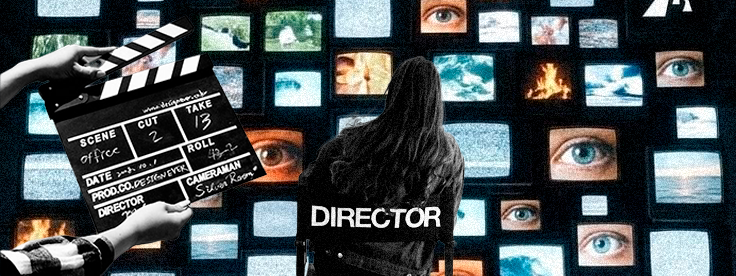
Instead, I've started treating my thoughts like casting auditions.
3, 2, 1... action.
Let the thought perform. Hear its pitch. See what it's got. But a thought appearing in my head doesn't mean it automatically gets the part. And when it stops bringing anything new to the scene?
Cut.
You think you're “processing.” But you've processed it. Several times. The factory is empty. Everyone has gone home. You're just wandering around turning the machines back on.
And I think that's why rumination can be particularly sneaky for people who are actually good at solving things.
Thinking has worked for us. We have evidence.
I once refused to send a concept over until I'd quietly reworked a design eight separate times, convinced it wasn't sharp enough yet. It got approved without a single note.
So now I have a case study. Exhibit A: sometimes an extra lap really does produce the better answer.
That same day my colleague saw the original design when I was sharing my screen and shattered my illusion by saying "Ah, that would have worked too!"
That's the whole trap. One good result and the habit gets tenure.
We've thought our way through difficult decisions. Anticipated problems before they happened. Connected dots other people missed. Found the third option when everyone else was arguing between one and two.
So when uncertainty appears, our brain reaches for its favourite tool. More thinking. And more thinking. And just a little more thinking in case the forty-third lap contains information the previous forty-two somehow missed.
Except the eighth version of that design wasn't the only act. It was rehearsal that happened to land. Confuse the two often enough and you stop being able to tell them apart.
But intelligence can't solve for missing data. Creativity can't either. You can generate possibilities. You can make predictions. You can construct increasingly convincing theories. But eventually you reach the border between what you know and what you don't. And no amount of pacing around inside your own head moves that border.
Something has to happen. Someone has to respond. The meeting has to take place. The results have to arrive. The other person has to tell you what they're thinking.
Reality has to contribute.
Until then, you're writing fiction.
And fiction gets dangerous when you forget you're the author.
Because after enough repetition, one possible version of events starts feeling suspiciously like the version of events.
That's another thing I've noticed about rumination. It isn't always investigation. Sometimes it's rehearsal. You're not discovering anything new. You're repeatedly practising one possible reality.
You rehearse the conversation that hasn't happened. The rejection nobody has given you. The project that hasn't gone wrong. The problem that hasn't materialised. The entire future that apparently needs solving at 11:47pm.
And repetition is persuasive. A thought doesn't necessarily start feeling true because you've found more evidence for it. Sometimes it starts feeling true because you've simply heard it a lot.
That's a dangerous promotion to give a thought that hasn't supplied references.
So now, when I notice myself doing another lap, I hold auditions.
3 — Name the role
What exactly is this thought auditioning for? Be specific. Not: I'm worried about the pitch. Boring.
Try: Creative Director Who Apparently Needs To Produce Twelve Solutions To Feedback That Does Not Yet Exist.
Or: Woman Who Must Solve Thursday Before Tuesday Has Happened.
Or: Person Who Has Mistaken Having An Imagination For Having Insider Information About The Future.
Much better.
Naming the role does something surprisingly useful. It separates the thought from reality. I'm not denying the possibility. I'm just remembering that it's currently a possibility. It's auditioning. It hasn't got the part.
2 — Check the casting brief
What do I actually know? Not suspect. Not predict. Not “have a feeling about.” Know.
What information supports the story? What information contradicts it? And what information simply does not exist yet?
That last category is the important one. Because sometimes the answer genuinely is: I don't know yet.
I hate that answer. My brain considers it a personal challenge. Surely we could know if we just...
No. We can't.
Sometimes uncertainty isn't a puzzle. It's a waiting room. And you don't get out of a waiting room by thinking harder.
1 — Is there an action?
This is where the audition ends.
Can I do something useful with the information I currently have? Send the email. Ask the question. Make the decision. Fix the thing. Write the idea down. Have the conversation. Prepare what can actually be prepared.
If yes: do it.
If no: cut.
Not because the thought is stupid. Not because it's definitely wrong. Not because we're forcing ourselves to “think positively.” God forbid.
Even the slide that got approved doesn't get to skip the audition next time. Good result once. Doesn't mean tenure.
It gets cut because it has stopped producing anything useful. Audition over. Thank you for coming. We'll be in touch. We will not be in touch.
And then — this part matters — I physically change scenes.
I stand up. Go outside. Train. Make food. Call someone. Get in the ocean. Do something involving the actual world rather than continuing negotiations with the imaginary one.
I've learnt not to argue with a closed loop. I leave the set.
That's become the point of 3, 2, 1... cut for me. Not controlling which thoughts appear. That's unrealistic. My brain can audition whoever it wants. The brilliant solution can come in. Worst-case scenario can read. The completely unnecessary Plan F apparently has representation. Fine. They can all audition.
But auditioning isn't employment.
A thought worth investigating gets investigation. A problem worth solving gets action. A possibility worth remembering gets written down. But a thought I've already examined fourteen times doesn't automatically get a fifteenth audition because it returned wearing glasses.
At some point, you've thought about it enough.
Reality has the next line.
Let it speak.



Join the conversation
What landed for you?
Comments are reviewed before appearing.
Loading thoughts...